Content #
- as soon as As soon as I sat down, the turned on the TV.
- while She washed the dished while he dried them. 男人女人同时在做不同的事。
- until She was my boss until she quit last month. 女人在辞职之前都是他的老板。
 September 15, 2024
September 15, 2024
September 15, 2024
September 15, 2024
September 15, 2024
September 15, 2024
September 15, 2024
用when时要用时态来表示清楚事件发生的先后顺序 while通常指一段时间 两个一般过去时句子之间添加连词来表示事件发生的顺序 过去进行时的被动语态(was/were being)
forget to do & forget doing remember to do & remember doing try to do & try doing stop to do & stop doing would & used to wind down be about to & be due to & be to
表达恼怒的句型 讽刺地表达烦燥 表达主观推断 依我看 表达精确信息(very, right) 持保留意见&表达反驳 柔和地表达不同意 表达模棱两可的意味 坚定的决心 描述某人的特质 辞职的原因 应对惨淡的就业市场 重述对方观点
September 11, 2024
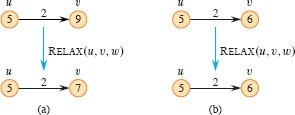
For each vertex v, the single-source shortest paths algorithms maintain an attribute v.d, which is an upper bound on the weight of a shortest path from source s to v.
The process of relaxing an edge (u,v) consists of testing whether going through vertex u improves the shortest path to vertex v found so far and, if so, updating v.d and v.π.
RELAX(u, v, w)
if v.d > u.d + w(u, v)
    v.d = u.d + w(u, v)
    v.π = u
 September 10, 2024
Shortest path cannot contain a negative-weight cycle, nor cat it contain a positive-weight cycle, since removing the cycle from the path produces a path with the same source and destination vertices and a lower path weight.
Shortest path have no cycles, that is, they are simple paths. Since any acyclic path in a graph G=(V,E) contains at most |V| distinct vertices, it also contains at most |V|-1 edges. Therefore, any shortest path contains at most |V|-1 edges;
...
September 10, 2024
If the graph contains a negative-weight cycle reahable from s, however, shortest-path weights are not well defined.
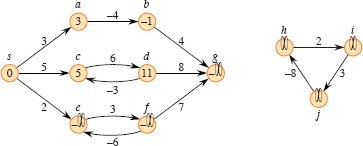
There are infinitely many paths from s to c:
<s,c>, <s,c,d,c>, <s,c,d,c,d,c>, ...
The shortest path from s to c is <s,c>.
There are infinitely many paths from s to e:
<s,e>, <s,e,f,e>, <s,e,f,e,f,e>, ...
Because the cycle <e,f,e> has weight -3, however, there is no shortest path from s to e.
...
September 6, 2024
September 6, 2024
人类语言的另一独特之处是元音的发音。没有元音便不可能有语言,元音将一串声音切分为易于分辨的小节(音节)从而形成词语。长期以来人们认为猴类和猿类无法发出元音,因其口腔和喉腔构造欠佳。然而,几项最新研究发声方式的结果表明,狮尾狒和猕猴等能够发出类似的元音。这意味着在进化的过程中,远在人类出现之前,人类话语的发声机制便已存在。
问题不在于发声机制,而在于协调发声和赋予声音意义的认知机制(但长尾黑颚猴的研究表明,最后这点存在疑问)。换言之,我们已能在旧世界猴身上看到许多人类话语的雏形。长尾黑颚猴的呼叫声是一种原始语原型,随意发声来指代具体物体,传达谁在做什么的信息(或将要做什么)。此外,呼叫声背后隐含着不同程度的情感含义,一如我们的语言表达。
可见,语言的产生无须经过手势阶段演变而来,声音表达足以。由此进化形成固定声音模式仅需一小步,便可传达更多信息,然后再向前一小步,便可产生语言。
《梳毛、八卦及语言的进化》 [英]罗宾·邓巴
September 6, 2024
需要读入的数据如下:
4
1 2 3 4
2 1 3
3 1 2 4
4 1 3
0
0
最开始的数字N,表示图的节点的个数,接下来若干行。每行的第1个数字表示起点u,后续的数字v表示从u开始到v有一条边。如果第1个数字为0,表示图的输入结束。
读取的代码如下:
int N;
while (cin >> N && N > 0) {
    string s;
    while (getline(cin, s)) {
        istringstream iss(s);
        int u;
        iss >> u;
        if (u == 0) break;
        int v;
        while (iss >> v) {
            //...
        }
    }
}
上面的代码存在换行符陷阱。读取N后,第1行的换行符还在,接下来调用 getline时,会得到空行,第1轮循环会马上结束,进入第2轮循环后会将第2行的第1个数字当作N读进来,导致数据读取错误。
解决方法是在读取N后,调用cin.ignore()来丢弃换行符:
int N;
while (cin >> N && N > 0) {
    cin.ignore(); //忽略当前的换行符,没有这一句,第一次调用getline会得到空行。
    //...
}
getline官方文档说明: When consuming whitespace-delimited input (e.g. int n; std::cin >> n;) any whitespace that follows, including a newline character, will be left on the input stream. Then when switching to line-oriented input, the first line retrieved with getline will be just that whitespace. In the likely case that this is unwanted behaviour, possible solutions include:
...